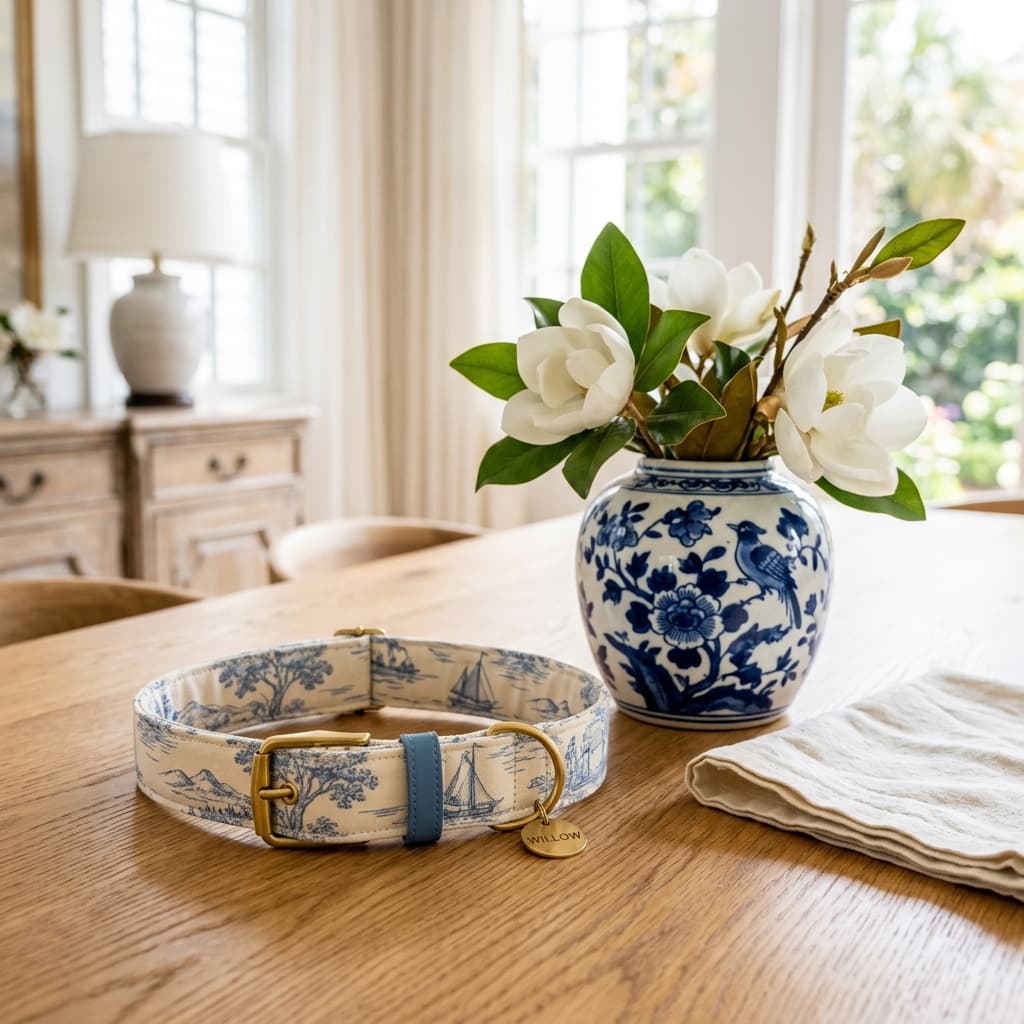
The honest version of how a brand gets started rarely involves a lightbulb moment. It usually starts with frustration — a specific, recurring problem that you've solved badly for long enough that you finally decide to solve it properly.
This is that story. Not a polished origin myth, just the actual sequence of events that led from a shopping problem to a brand.
The Problem We Couldn't Solve by Shopping
We are dog moms who care about our homes. Not in an interior design magazine way, but in the way that most women who spend time building a visual environment do — thoughtfully, specifically, with a clear sense of what the space should feel like.
The dog is always in the space. The dog is in the photos. The dog is on the couch, at the front door, in the garden. And the dog's accessories — the collar, the lead, the dog bed in the corner — exist in a completely different aesthetic universe than everything else we had chosen for our homes.
We searched. The Foggy Dog makes beautiful nylon collars, but nylon gets wet and starts to smell and the prints fade after a season. Wild One is excellent quality, minimal, deliberately not patterned — wrong aesthetic entirely. Etsy has everything and nothing: the quality is inconsistent and finding what you actually want requires hours of searching. The Gucci collar exists as a concept but it's canvas and costs $300 and the logo is the entire point.
What we wanted didn't seem to exist: a traditional patterned collar in a waterproof material that could survive a real dog's life. That specific intersection — aesthetic intentionality plus material durability — wasn't being served.
The Gap We Saw
The more we looked, the more specific the gap became. Three things we cared about:
Traditional design aesthetic. Grand Millennial, Lowcountry, coastal — the visual language of toile, chinoiserie, botanical illustration, and patterns with genuine design history. No one in pet accessories owned this aesthetic.
Waterproof material. For dogs who live in the South, near the water, or anywhere with mud and rain, nylon and leather are constant maintenance problems. Biothane solves the waterproof problem but has no design language. Nothing solved both.
Accessible price. True luxury collars are over $150. The Grand Millennial dog mom isn't looking for a status symbol — she's looking for a beautiful, well-made thing that doesn't cost more than her dinner out. The $30–60 range is the right space.
No brand occupied that intersection. That was the brand.
Why Silicone
The material question took real research to answer. We knew we wanted something genuinely waterproof — not water-resistant, not treated, actually non-porous. Biothane had the waterproofing but not the design capability. We needed a material that could carry complex print designs without a surface coating that would eventually degrade.
Silicone solved both problems. It's the material used in FDA food-grade cookware, medical devices, and baby products — non-toxic, non-porous, and stable across temperature and moisture conditions. Its color can be embedded in the material rather than printed on the surface, which means the design doesn't fade or chip the way surface-printed collars do.
Once we understood silicone, it was the obvious answer. The question was why it hadn't already been done — and the answer is that pet accessories brands move slowly, especially toward more expensive materials. Nylon is cheap. Silicone requires real investment in the tooling and production process. Most brands default to what's established.
Why Charleston
We're based in Charleston, South Carolina, and the Lowcountry is genuinely the right design anchor for what we're building — not just because we live here, but because the visual culture of this region maps directly to the aesthetic we care about.
Charleston has maintained a relationship with traditional pattern and ornament that most American cities abandoned to modernism. The architecture — the single houses, Rainbow Row, the garden gates — is genuinely beautiful and historically layered. The indigo dyeing traditions of the region, the sweetgrass basketry, the palmetto motif that runs through everything — these are a real regional design vocabulary with centuries of history.
The Lowcountry is also, practically speaking, exactly the environment a waterproof dog collar was designed for: salt water, humidity, morning rain, beach sand, tidal creeks. If it works here, it works anywhere.
What We're Building
The first Lu & Liv collection is in development with a designer who shares our aesthetic commitment. The prints are original — no licensed patterns, no stock art. Each design is rooted in the Lowcountry visual tradition: the toile, the botanical illustration, the chinoiserie that has run through Charleston's decorative arts for generations.
"Heirloom-quality" is a phrase that gets used loosely. What it means to us: a collar that looks better the longer you have it, that holds its design as the material holds up, that you don't have to replace every season. That's the product we're building.
We're pre-launch. Join the waitlist below to see the first collection when it drops — and to claim your launch discount before the public sale opens.
Join the Waitlist
We're almost ready to launch. If you want to be the first to see the collection — and claim your launch discount — join below.
You'll be the first to see the collection · 15% off at launch · Unsubscribe anytime.