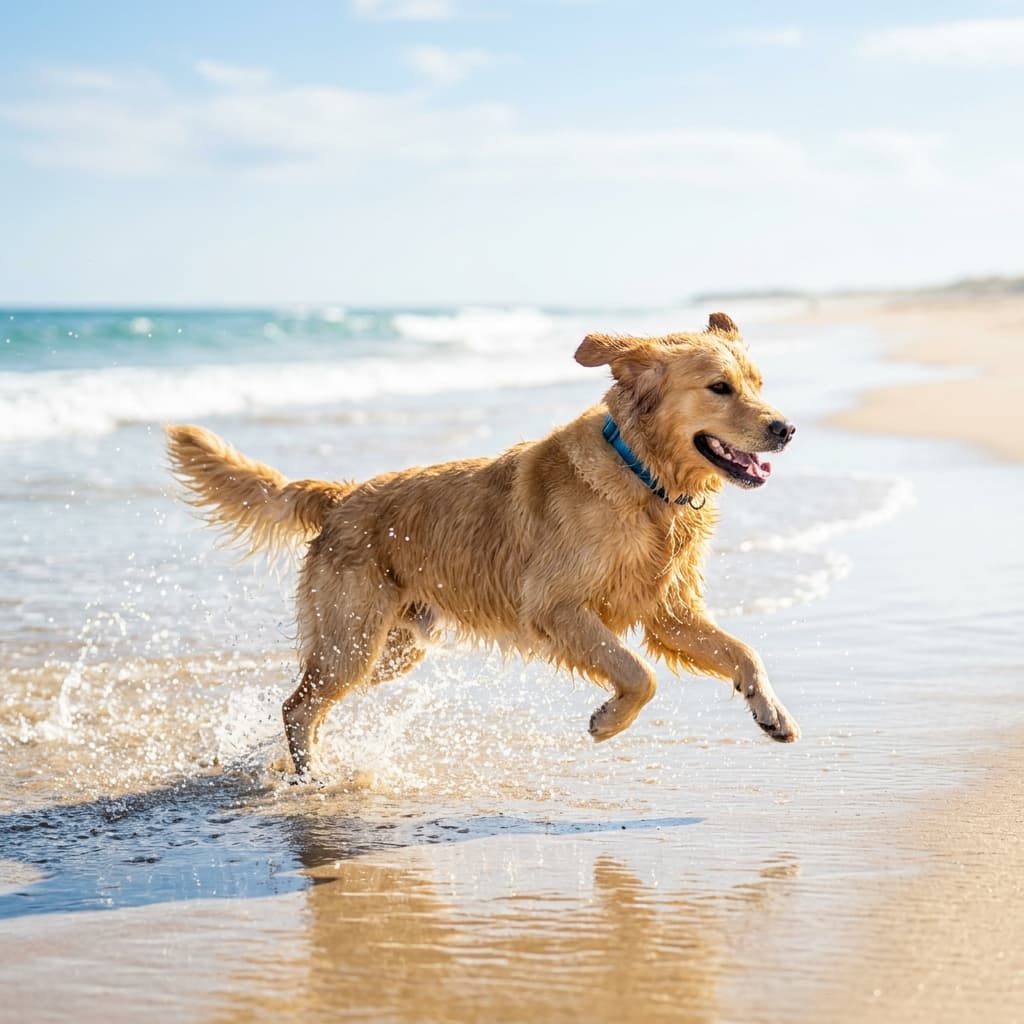
If you've ever picked up your dog's collar after a beach day — soggy, starting to smell, stitching pulling away from the buckle — you already know the problem. Most people wash it, hang it to dry, and by the third wet season it smells like mildew no matter what they do.
The issue isn't care. It's material. Most dog collars are made for a world where dogs stay dry — not for the actual dog life of salt water, creek beds, morning rain, and that specific mud patch they find every single time.
Waterproof dog collars aren't a specialty product for adventure breeds anymore. For any dog who actually lives in the world — which is every dog — they're the logical default. Here's what makes a collar truly waterproof, why the most common alternatives fall short, and what to look for when buying.
What Does "Waterproof" Actually Mean for a Dog Collar?
The word gets applied loosely. Most collars marketed as "waterproof" are actually water-resistant — and the difference is significant.
Water-resistant means the material has a surface treatment or coating that causes water to bead up. Nylon is often treated this way. But coatings wear down with use, sun exposure, and repeated washing. Stitching and seams are typically uncoated entirely. And the underlying nylon weave is still porous — water eventually gets through.
Truly waterproof means the material itself doesn't absorb water. There's no coating to degrade because the material is non-porous at its core.
Right now, there are two collar materials that are genuinely waterproof at the material level: biothane and silicone. Everything else — nylon, leather, canvas, hemp — is water-resistant at best.
| Material | Truly Waterproof? | Odor Risk | Print Design | Expected Lifespan |
|---|---|---|---|---|
| Nylon | No (water-resistant only) | High after repeated exposure | Good initially | 1–2 years active use |
| Leather | No | High when wet | Limited | Requires regular conditioning |
| Biothane | Yes | Very low | Solid colors only | 5+ years |
| Silicone | Yes | Very low | Excellent, embedded | 5+ years |
Why Nylon Collars Fall Short in Wet Conditions
Nylon is the default material for good reasons: it's affordable, lightweight, and available in every color imaginable. In dry conditions, it performs fine. The issue is that it's a woven material — and woven means porous.
When nylon absorbs water repeatedly, a few things happen over time:
Odor accumulates. Wet nylon doesn't dry completely, especially at seams and around hardware joints. That trapped moisture becomes a reliable environment for mildew. By the second or third wet season, the smell doesn't wash out.
The collar weakens structurally. Repeated saturation and drying cycles degrade the weave over time. Stitching frays, the webbing softens and loses integrity, and buckle attachment points loosen. Even if the collar looks okay, it may not be.
Dye fades. Nylon dye isn't locked in. Water, UV exposure, and repeated washing strip even bold colors within a year or two of active use.
None of this is a knock on nylon for dry-climate, low-activity dogs. It works fine in those conditions. But for any dog with a beach, a creek, a pool, or a coastal backyard — nylon is consistently working against you.
Why Leather Doesn't Solve the Problem
Leather occupies the premium tier in most buyers' minds — and it does look beautiful. The problem is what happens when leather meets water, repeatedly.
Leather is protein fiber. When it gets wet and dries, it loses natural oils. Over repeated wet-dry cycles, it stiffens. Then it cracks. Eventually, it flakes. High-quality conditioners slow this down, but they don't prevent it — especially for a dog in a humid or coastal climate who wears their collar every single day.
There's also the smell. Saturated leather has a specific odor that most people find unpleasant and that doesn't respond well to typical cleaning. Combined with the maintenance burden — conditioning, proper drying, avoiding direct sun — leather is a demanding choice for daily wear.
Leather is a genuine craft material with real beauty. It's just wrong for a dog who lives outside.
The Two Genuinely Waterproof Options
If material-level waterproofing is the standard, your choices are biothane or silicone.
Biothane is a coated polyester webbing — the working dog world's answer to wet conditions for decades. It's been the standard for hunting dogs, service dogs, and serious outdoor enthusiasts. Nearly indestructible, easy to clean with a quick wipe, and available in a solid range of colors. The primary trade-off: biothane is almost always solid or two-toned. The design space for patterned biothane is essentially nonexistent.
Silicone is the newer entrant — and it's changed what's possible. Silicone is a polymer, the same class of material used in food-grade cookware, medical devices, and baby products. Non-porous, odor-resistant, temperature-stable, and — critically — capable of carrying complex embedded print designs. The artwork isn't surface-coated; it's integrated into the material, so it won't wear off the way a surface print would.
Both materials are the correct choice over nylon or leather for any dog who regularly gets wet. The decision between them comes down to whether the collar's design matters to you.
What to Look for When Buying a Waterproof Dog Collar
Material first. Biothane or silicone means genuinely waterproof. "Water-resistant nylon" or "treated webbing" does not.
Hardware matters more than people expect. Standard budget hardware is zinc alloy — it rusts, especially with salt water exposure. Look for stainless steel or marine-grade zinc. Corroded hardware is both visually poor and a structural risk at the most critical point of the collar.
For printed collars: how is the print applied? Surface-printed designs wear off with flex and friction. Color-embedded prints are part of the material and won't. Look for this information in the product description — it matters for a collar that's meant to last.
Sizing. Adjustable is better than fixed for most dogs — neck size fluctuates with seasonal coat changes and normal weight variation. Make sure the adjustment range has real room on either end.
Cleaning simplicity. A truly waterproof collar should clean easily: rinse with warm water, wipe dry. If the manufacturer recommends special products or extended drying time, the collar likely has coated or treated components that aren't as waterproof as marketed.
Is a Waterproof Dog Collar Worth the Higher Price?
The economics make a simple case. A quality nylon collar costs $20–30. For an active dog, it develops odor and starts degrading within 6–12 months of regular water exposure. By the two-year mark, you've likely replaced it once or twice — $40–60 total, for a product that smelled for half its life.
A quality silicone collar runs $40–55. No odor. No cracking. No color fade. With normal use, it lasts 5 or more years.
The "premium" framing is actually backwards. The waterproof collar is the more economical choice when you factor in the real lifespan. You're paying once for something that performs better across every scenario — not paying repeatedly for something that works until it doesn't.
The Bottom Line
For any dog with a real outdoor life — beaches, trails, backyard mud, coastal humidity, morning rain — waterproof construction isn't a luxury upgrade. It's the rational baseline. Silicone has closed the gap that biothane couldn't: you no longer have to choose between the collar that lasts and the collar that looks like it belongs in your home.
At Lu & Liv, we make waterproof silicone dog collars with original print designs rooted in the Lowcountry aesthetic. See our silicone collar collection or join the waitlist below to be first to shop when we launch.
Join the Waitlist
We're almost ready to launch. If you want to be the first to see the collection — and claim your launch discount — join below.
You'll be the first to see the collection · 15% off at launch · Unsubscribe anytime.