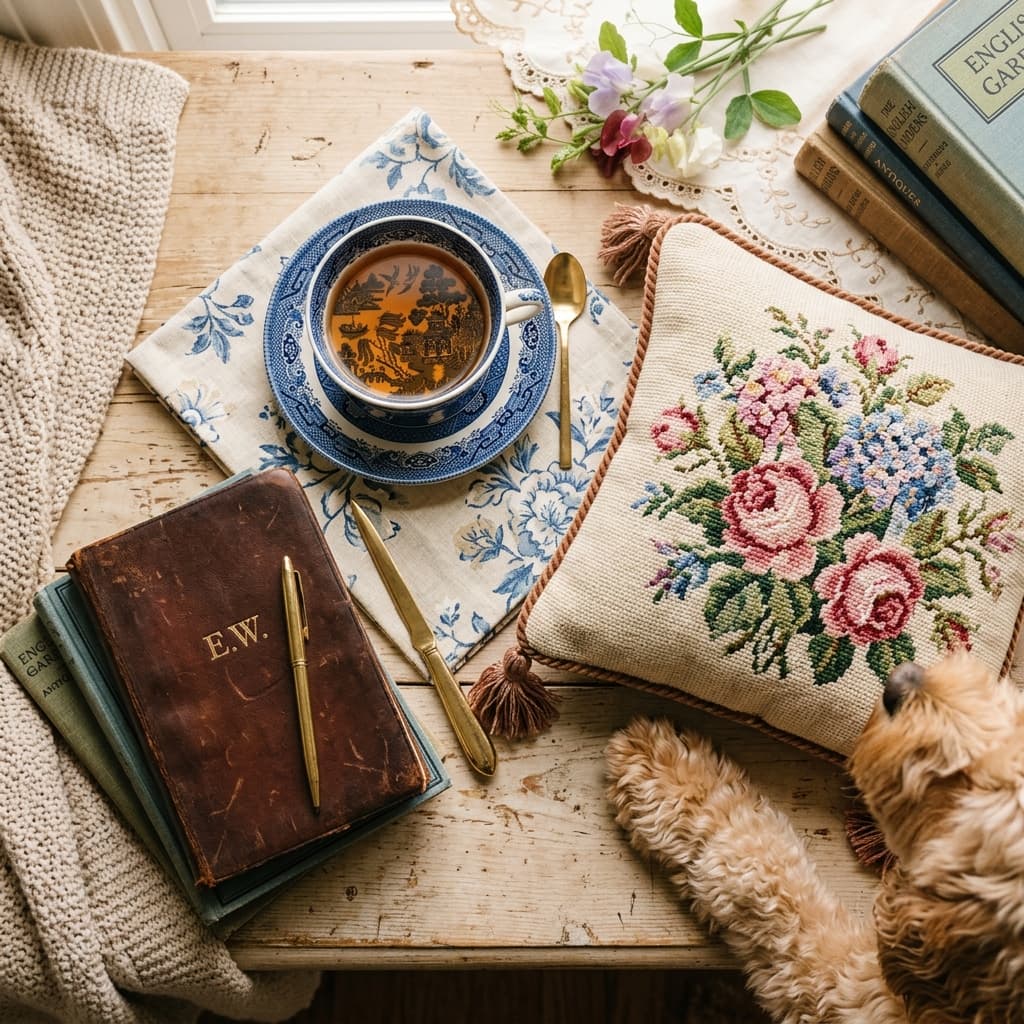
The interior design world got its Grand Millennial revival around 2019. Pattern-on-pattern rooms started appearing on Pinterest. Chinoiserie wallpaper sold out. Toile came back — not ironically, just sincerely, because it's beautiful and it was always beautiful.
The pet accessory market is about five years behind. Most dog collars are still designed for one of two aesthetics: the outdoor-active market (solid colors, utility hardware, built for mud) or the mass market (cartoon patterns, cheap prints, whatever sells at PetSmart). Neither speaks to the woman with the intentionally curated home who also happens to have a dog.
That gap is exactly where Lu & Liv lives. This guide covers the full aesthetic — the patterns, the references, the styling principles — and explains why the Grand Millennial dog is the most underserved aesthetic customer in the pet accessories market right now.
What Is the Grand Millennial Aesthetic?
The term "Grand Millennial" was coined by House Beautiful around 2019–2020 to describe a design movement it was observing among younger women: a genuine, unselfconscious embrace of everything maximalist, traditional, and heirloom-adjacent that minimalism had told their generation to reject.
The core characteristics: traditional patterns (toile, chintz, chinoiserie), maximalism done with intention rather than accumulation, heirloom objects mixed with new purchases, layered interiors with real visual depth, and a sensibility that values history and craft over the clean lines of Scandinavian-influenced modern design.
It's not nostalgia for its own sake. It's a correction — a recognition that the design vocabulary of the 18th and 19th centuries is genuinely rich, visually sophisticated, and more interesting than a white wall and a single statement plant. Millennials and Gen Z women didn't grow up loving these patterns. They're choosing them now because they're actually good.
The Grand Millennial Pattern Vocabulary
Understanding the patterns is the foundation. Each one has a specific history and visual character that distinguishes it from the others.
Toile de Jouy originated in 18th-century France — specifically in Jouy-en-Josas, outside Paris, where a factory began producing intricate scenic prints on cotton in single colors against a cream or white ground. The scenes depict pastoral life, mythological subjects, and exotic landscapes. Toile is immediately recognizable by its two-color palette (the classic is blue or red on cream) and its detailed, engraving-like vignettes. It reads as both refined and warm — formal enough for a dining room, comfortable enough for a bedroom.
Chinoiserie is a European interpretation of Chinese design motifs that developed from the 17th century onward, as trade with Asia introduced porcelain, lacquerware, and textiles to European courts. The design language includes pagodas, exotic birds (the phoenix, the peacock), flowering trees, bamboo, and landscapes rendered in a stylized, fanciful rather than realistic manner. The classic palette is blue and white, after the Delft and Chinese blue-and-white porcelain tradition — though full-color chinoiserie in jade, terracotta, and gold also has a long history.
Botanical illustration has its roots in 18th and 19th-century scientific illustration — the detailed drawings commissioned to document plants for botanical encyclopedias and natural history collections. What makes these prints distinctive is their complexity: full plant specimens with roots, stems, leaves, and flowers rendered in precise detail. The palette tends toward naturalistic greens, dusky roses, and aged cream.
Needlepoint-inspired prints translate the pixelated, high-craft quality of needlepoint embroidery into print design. They carry warmth and texture even in flat form — because they reference something made by hand, stitch by stitch. Maximalist, detailed, and immediately legible as "traditional."
Vintage florals are distinct from the pastel watercolor florals that saturated the early 2010s market. Think Liberty of London, William Morris, and the historic textile traditions of England and France: complex, layered, with real botanical specificity rather than decorative vagueness.
The Grand Millennial Dog Mom — Who She Is
She's the one with the well-styled home and the dog who shows up in every corner of it. She has a Pinterest board with twelve sub-boards and a specific vision for what her home feels like. She buys antiques thoughtfully and new things intentionally.
Her dog's collar has always been the weak link. She shops The Foggy Dog because it's the closest thing available — lovely prints, but nylon, and it gets wet. She looks at Etsy for something with more aesthetic specificity, but quality control is inconsistent. She doesn't buy the Gucci collar — she knows she's paying for a logo — but she understands why it exists as a concept.
What she actually wants is simple: the same intentionality she brings to her home, extended to her dog's accessories. A collar that looks like it was chosen, not grabbed. A material that holds up to real life. An aesthetic that belongs to a tradition she genuinely loves.
Grand Millennial Dog Collar Patterns — What to Look For
Not all traditional-looking prints are created equal. Here's how to identify quality Grand Millennial prints in the dog accessories market:
For toile: look for two-color scenic prints with genuine narrative detail. Avoid simplified or digitally pixelated versions — they lose the engraving quality that makes toile distinctive. The design should feel like it has a story, not just a repeat.
For chinoiserie: the blue-and-white palette is classic and immediately legible, but jade-and-cream or terracotta-and-gold are more unexpected and equally authentic. The key is the motif vocabulary — pagodas, birds, flowering branches — rendered with care, not approximated.
For botanical: the pattern should feel complex and layered. A single flower on a solid field is decorative but it's not botanical illustration. The real thing has stems, leaves, roots, and variation — it looks like it was observed from life, even if stylized.
Quality Grand Millennial prints are distinguishable from trend-chasing imitations by their specificity. They reference a real design tradition with real visual history. The difference is visible once you start looking for it.
Styling Your Dog's Accessories for the Grand Millennial Aesthetic
The collar is the anchor. Everything else should support it rather than compete with it.
When the collar has a maximalist pattern — toile, chinoiserie, a dense botanical — keep the lead simple. A solid leather lead or a minimal silicone lead in a single color from the collar's palette lets the collar read without visual noise.
Color palette cohesion matters. Stay within the collar's dominant color family for any accessories you add. A blue-and-white chinoiserie collar pairs naturally with cream, navy, or sage. A blush botanical collar works with terracotta, ivory, or soft green.
Think about context when photographing. The Grand Millennial aesthetic photographs best in environments that share its DNA: a garden, a front porch with architectural detail, an interior with pattern wallpaper or good textiles. The collar reads stronger when its surroundings reinforce the aesthetic than when it's photographed against a blank wall.
The Charleston Connection
If there's a geographic epicenter for the Grand Millennial aesthetic in the United States, it's Charleston and the broader Lowcountry. The city's architecture, gardens, and interior design culture have maintained a relationship with traditional pattern and ornament that most American cities lost to modernism. Rainbow Row. The single houses with their garden gates. The interior spaces filled with antiques, chinoiserie cabinets, botanical prints, and hand-blocked wallpapers.
The Lowcountry also has its own design vocabulary — the indigo dyeing traditions of the antebellum plantations, the palmetto and live oak motifs that run through the region's visual identity, the sweetgrass basketry tradition that has been woven in the area for centuries. This is the design context that Lu & Liv draws from directly. Our prints are rooted in this specific place and its visual history, not in a generic "traditional" aesthetic that could have come from anywhere.
If you're building the Grand Millennial dog mom aesthetic, Charleston gives you a specific anchor. It's not just "old-fashioned" — it's rooted in a real regional design tradition with genuine depth.
The Gap Is Closing
The Grand Millennial dog is underserved, but not for much longer. The design language is established. The customer is clearly defined. The material now exists — silicone — that can carry these patterns without sacrificing the durability an active dog needs.
Lu & Liv is building the first collection designed explicitly for this aesthetic, rooted in the Lowcountry and made to last. Browse our Grand Millennial dog accessories, explore our toile dog collars and botanical collar collection, or join the waitlist below to see the first collection before it launches.
Join the Waitlist
We're almost ready to launch. If you want to be the first to see the collection — and claim your launch discount — join below.
You'll be the first to see the collection · 15% off at launch · Unsubscribe anytime.